Java vs Python : Which Programming Language Should You Learn in 2026?
Confused between Java and Python? Compare syntax, performance, jobs, AI, web development, salaries, and career opportunities to choose the right programming language in 2026.

INTRODUCTION
Choosing your first programming language isn't just about learning syntax it's about choosing a path that aligns with your career goals.
Two languages dominate the programming world: Java and Python. Both are beginner-friendly, widely used, and trusted by companies worldwide. However, they excel in different areas.
If your goal is to build enterprise applications, backend systems, or Android apps, Java is an excellent choice. If you're interested in artificial intelligence, data science, or automation, Python often provides a faster and more beginner-friendly starting point.
In this guide, we'll compare Java and Python based on syntax, performance, career opportunities, and real-world use cases to help you decide which language to learn in 2026.
Quick Answer
If you're short on time, here's the simple answer:
Learn Java if you want to become a backend developer, Android developer, or work with enterprise applications.
Learn Python if you're interested in AI, machine learning, automation, or data science.
If you're still unsure, Python is generally easier for beginners, while Java provides a stronger understanding of programming fundamentals.
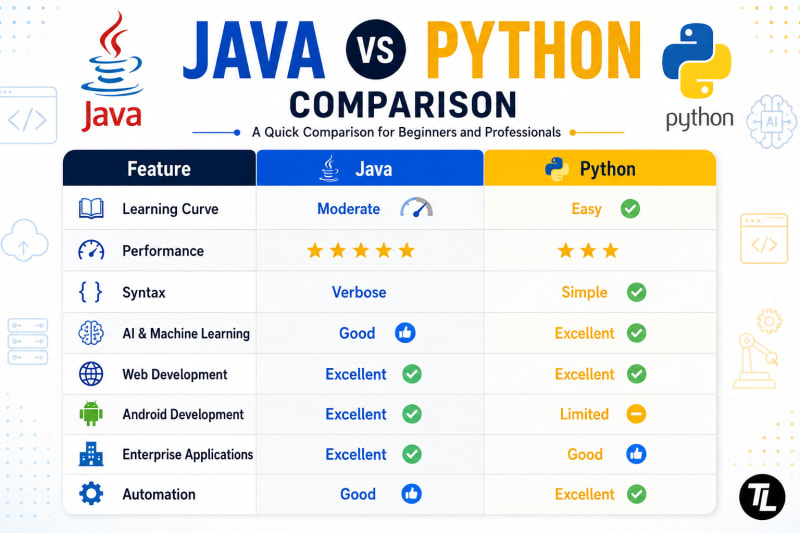
Java vs Python at a Glance
What is Java?
Java is a high-level, object-oriented programming language developed by Sun Microsystems (now Oracle). One of its biggest strengths is its "Write Once, Run Anywhere" philosophy, which allows Java programs to run on any device with a Java Virtual Machine (JVM).
Java is widely used in industries where performance, security, and reliability are critical.
Common use cases include:
Enterprise applications
Banking software
REST APIs
Cloud applications
Android development
Microservices
If you're new to Java, we recommend starting with our Write Your First Java Program guide before exploring advanced topics.
Java Example
public class Main {
    public static void main(String[] args) {
        System.out.println("Hello, World!");
    }
}
Although Java requires more code than Python, its structured approach helps beginners understand important programming concepts like classes, methods, and objects.

What is Python?
Python is a high-level programming language designed with simplicity and readability in mind. Its clean syntax allows beginners to write programs with very little code, making it one of the easiest languages to learn.
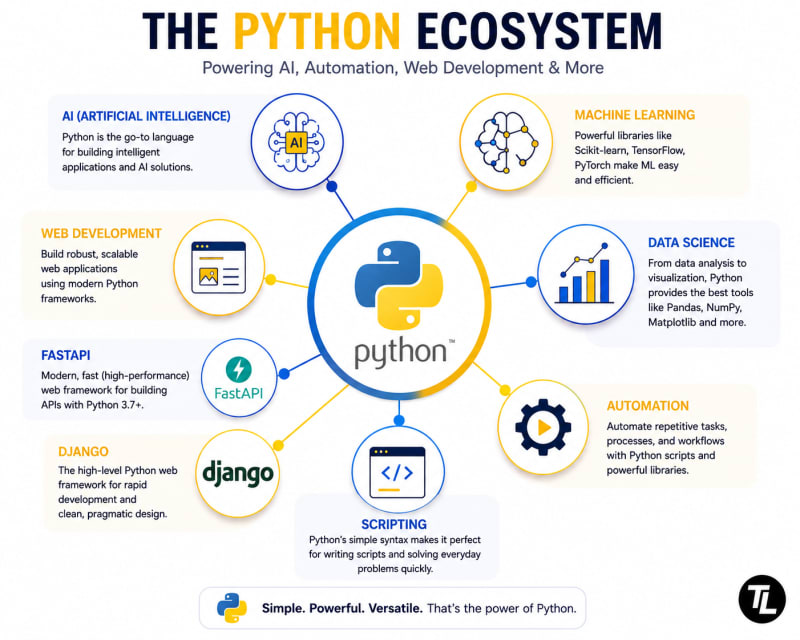
Python has become the first choice for many developers working in artificial intelligence, automation, machine learning, and data science.
Popular use cases include:
AI & Machine Learning
Automation
Web Development
Data Analysis
Scripting
Cybersecurity
If you're just starting your Python journey, begin by installing Python and writing your first program before exploring advanced libraries.
Python Example
print("Hello, World!")As you can see, Python requires only a single line to produce the same output as the Java example.
This simplicity allows beginners to focus more on problem-solving rather than language syntax.
Java vs Python: Syntax Comparison
One of the biggest differences between Java and Python is how much code you need to write.
Java
int a = 10;
int b = 20;

System.out.println(a + b);
Python
a = 10
b = 20

print(a + b)
Python removes much of the extra syntax required in Java, making it easier to read and write. However, Java's stricter structure helps beginners understand programming concepts such as data types, object-oriented programming, and code organization.
Performance Comparison
Performance is another area where Java and Python differ.
Java code is compiled into bytecode and optimized by the Java Virtual Machine (JVM), allowing applications to run efficiently. This makes Java a popular choice for large-scale enterprise systems where speed and reliability are important.
Python is an interpreted language, which means it generally executes code more slowly than Java. However, for many tasks such as scripting, automation, and AI development, this difference isn't noticeable because much of the heavy computation is handled by optimized libraries.
For most beginners, performance shouldn't be the deciding factor. Instead, focus on choosing the language that aligns with the type of projects you want to build.
Learning Curve
Python is often recommended as the best first programming language because of its clean syntax and minimal setup. Beginners can start writing useful programs within minutes.
Java has a steeper learning curve because you'll encounter concepts like classes, objects, methods, and the JVM early in your journey. While this may seem challenging at first, it also builds a strong foundation in software development.
Many universities still teach Java because it introduces students to structured programming and object-oriented design from the beginning.
Career Opportunities
Both Java and Python offer excellent career opportunities in 2026. The right choice depends on the type of software you want to build.
Java Career Paths
Java continues to be one of the most in-demand programming languages for enterprise software development. Many banks, insurance companies, government organizations, and large tech companies rely on Java for their core systems.
Popular Java roles include:
Java Developer
Backend Developer
Spring Boot Developer
Android Developer
Software Engineer
Full Stack Developer
If you're interested in building scalable backend applications, you can continue learning with our Spring Boot Tutorial, where you'll build REST APIs and real-world projects.
Python Career Paths
Python dominates fields that involve data and automation. Its simple syntax and rich ecosystem make it the preferred language for AI engineers, data scientists, and automation developers.
Popular Python roles include:
Python Developer
AI Engineer
Machine Learning Engineer
Data Scientist
Automation Engineer
Backend Developer
Python is also widely used for scripting, cybersecurity, and cloud automation.
AI & Machine Learning
When it comes to Artificial Intelligence, Python is the clear winner.
Most modern AI frameworks are built with Python because of its simplicity and extensive library support.
Popular Python libraries include:
TensorFlow
PyTorch
NumPy
Pandas
Scikit-learn
OpenCV
These libraries allow developers to build recommendation systems, chatbots, image recognition software, and predictive models with relatively little code.
Java does have AI libraries, but its ecosystem is much smaller. For most AI and machine learning projects, Python remains the preferred choice.
Web Development
Both Java and Python are capable of building modern web applications, but they use different frameworks.
Java
The most popular Java framework is Spring Boot.
Spring Boot makes it easy to build secure, scalable, and production-ready backend applications. It is widely used for REST APIs, microservices, and enterprise systems.
Java Example
@RestController
public class HelloController {

    @GetMapping("/")
    public String hello() {
        return "Welcome to TheTechLane!";
    }
}
This simple controller creates an API endpoint that returns a welcome message.
If backend development interests you, our Spring Boot Tutorial will help you build complete REST APIs from scratch.
Python
Python offers several excellent frameworks for web development.
Popular choices include:
Django
Flask
FastAPI
FastAPI has become especially popular because it's lightweight, modern, and extremely fast.
Python Example
from fastapi import FastAPI

app = FastAPI()

@app.get("/")
def home():
    return {"message": "Welcome to TheTechLane!"}
This code creates a simple API endpoint similar to the Java example but with much less code.

TheTechLane's Perspective
If someone asked us, "Which programming language should I learn first in 2026?", here's what we'd recommend.
If your goal is to get a software engineering job in backend development, especially in enterprise companies, start with Java. It teaches object-oriented programming, strong coding practices, and is the foundation of many large-scale applications built with Spring Boot.
If your dream is to work in Artificial Intelligence, Machine Learning, Data Science, or Automation, Python is the better starting point. Its clean syntax lets you focus on solving problems instead of writing lots of boilerplate code.
However, one mistake we often see beginners make is trying to learn every language at once.
Instead:
Pick one language.
Build real projects.
Understand programming fundamentals.
Learn data structures and algorithms.
Then expand to other languages as your career grows.
Many experienced developers know both Java and Python. The language gets you started, but your problem-solving skills and projects are what truly shape your career.
Which Language Should You Learn?
Here's a simple guide based on your goals.

Conclusion
Java and Python are two of the most powerful programming languages available today, and both continue to offer excellent career opportunities in 2026.
If you're aiming for enterprise software, backend development, or Android applications, Java is a solid investment that teaches strong programming fundamentals and powers some of the world's largest systems.
On the other hand, if you're excited about artificial intelligence, automation, data science, or rapid application development, Python offers an easier learning experience and an unmatched ecosystem.
Whichever language you choose, focus on building projects, practicing consistently, and understanding core programming concepts. Once you've mastered one language, learning another becomes much easier.
The best programming language isn't the one with the most features Fit's the one that helps you achieve your career goals.
Key Takeaways
Java and Python are both excellent choices for beginners.
Python has a simpler syntax and is easier to learn.
Java generally offers better runtime performance.
Java is widely used in enterprise software and backend development.
Python dominates AI, machine learning, automation, and data science.
Choose a language based on your career goals, not trends.
Master one language before trying to learn several at once.
Continue Learning
Whether you choose Java or Python, the best way to improve is by building a strong foundation and creating real projects.
If You Want to Learn Java
Understand Java Program Structure
Java Variables and Data Types
Java Operators
Java Control Statements
Build Your First Spring Boot REST API
If You Want to Learn Python
Install Python on Windows
Install Visual Studio Code for Python
Write Your First Python Program
Python Variables and Data Types
Python Operators
Python Conditional Statements
Python Loops
Build Your First FastAPI Project
Start with one language, stay consistent, and keep building. Every project you complete brings you one step closer to becoming a better developer.
Have a Question?
If you have any questions about DSA or programming, leave a comment below. We'll be happy to help.
Follow TheTechLane
Want more Java tutorials, programming tips, and developer resources?
Follow TheTechLane on LinkedIn, X, Instagram, Threads, and Pinterest to stay updated whenever a new tutorial is published.
Learn. Build. Share.
— TheTechLane