What Is a Compiler? A Beginner's Guide to Compiler Design
Learn what a compiler is, why it's essential, how the compilation process works, and how programming languages like Java are transformed into executable programs.
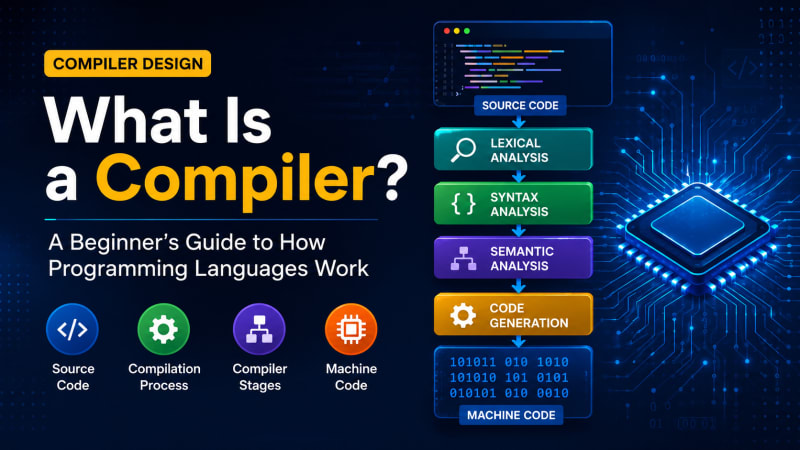
Introduction
If you've ever written a Java program, you've already used a compiler—even if you didn't realize it.
Consider this simple Java program:
public class Main {
    public static void main(String[] args) {
        System.out.println("Hello, World!");
    }
}
When you click Run, your computer doesn't execute this Java code directly.
Instead, the code goes through a sophisticated process that analyzes, validates, and transforms it into instructions your processor can understand.
This entire process is handled by a compiler.
Understanding how compilers work is one of the most valuable topics in computer science. Whether you're preparing for technical interviews, learning programming language design, or simply curious about what happens behind the scenes, compiler fundamentals provide a deeper understanding of software development.
In this guide, you'll learn:
What a compiler is
Why compilers are necessary
How the compilation process works
The different stages of compiler design
The difference between compilers and interpreters
How Java compiles your programs
Who Should Read This Guide?
This tutorial is ideal for:
Computer Science students
Java developers
Backend engineers
Developers preparing for interviews
Anyone interested in compiler design or programming languages
No prior knowledge of compiler design is required.
What Is a Compiler?
A compiler is a software program that translates code written in a high-level programming language into another form that a computer can execute.
Depending on the language, the output may be:
Machine Code
Assembly Language
Bytecode
Intermediate Representation (IR)
For example:
Java compiles to Bytecode
C compiles directly to Machine Code
Rust compiles to Native Machine Code
Without compilers, developers would need to write programs directly in machine language—an almost impossible task for modern software.
Why Do We Need a Compiler?
Computers only understand binary instructions.
Humans, however, prefer readable programming languages.
For example:
int age = 23;
System.out.println(age);
is easy for developers to understand.
The processor cannot understand keywords like int or System.out.println().
A compiler bridges this gap by converting human-readable source code into instructions that the processor can execute.
Modern compilers also perform several additional tasks:
Detect syntax errors
Verify variable declarations
Perform type checking
Optimize code
Generate executable programs
Without these checks, software would be significantly more error-prone.
How Does a Compiler Work?
Every modern compiler follows a series of well-defined stages.
Source Code
      │
      ▼
Lexical Analysis
      │
      ▼
Syntax Analysis
      │
      ▼
Abstract Syntax Tree (AST)
      │
      ▼
Semantic Analysis
      │
      ▼
Code Optimization
      │
      ▼
Code Generation
      │
      ▼
Executable Program
Each stage has a specific responsibility.
Let's examine each one.
Stage 1: Source Code
Everything begins with the source code written by the programmer.
int total = 5 + 3;
At this stage, the compiler simply receives a stream of characters.
It has not yet identified variables, operators, or expressions.
That happens during lexical analysis.
Stage 2: Lexical Analysis (Lexer)
The Lexer (or Tokenizer) scans the source code character by character and groups meaningful sequences into tokens.
For example:
int total = 5 + 3;
becomes
KEYWORD(int)
IDENTIFIER(total)
ASSIGN
NUMBER(5)
PLUS
NUMBER(3)
SEMICOLON
The lexer removes unnecessary whitespace and comments while preserving information needed by later stages.
Output: A stream of tokens.
Stage 3: Syntax Analysis (Parser)
The parser checks whether the sequence of tokens follows the grammar rules of the language.
For example:
int total = 5 + 3;
is valid.
However,
int = total +;
violates Java's grammar and results in a syntax error.
The parser ensures the structure of the program is correct before moving forward.
Stage 4: Abstract Syntax Tree (AST)
Once parsing succeeds, the compiler builds an Abstract Syntax Tree (AST).
Instead of storing code as plain text, it represents the logical structure of the program.
Example:
5 + 3
becomes
      +
     / \
    5   3
The AST is easier for later stages to analyze and optimize.
Almost every modern compiler internally works with some form of syntax tree.
Stage 5: Semantic Analysis
A program may have correct syntax but still be logically incorrect.
Consider:
int age = "Twenty Three";
This statement follows Java syntax but attempts to assign a String to an integer variable.
Semantic analysis catches issues such as:
Type mismatches
Undefined variables
Invalid assignments
Duplicate declarations
Incorrect function calls
Scope violations
If these checks fail, compilation stops.
Stage 6: Code Optimization
Modern compilers improve programs before generating executable code.
Common optimizations include:
Removing unused variables
Eliminating unnecessary calculations
Simplifying expressions
Reducing memory usage
Improving execution speed
The goal is to produce code that runs faster while preserving the program's behavior.
Stage 7: Code Generation
Finally, the compiler generates executable output.
For Java, the process looks like this:
  Main.java
      │
      ▼
    javac
      │
      ▼
 Main.class
      │
      ▼
Java Virtual Machine
      │
      ▼
JIT Compiler
      │
      ▼
Machine Code
Unlike C or C++, Java first generates Bytecode, which the JVM executes on different operating systems.
This architecture enables Java's Write Once, Run Anywhere (WORA) philosophy.
Common Misconceptions
"Java is an interpreted language."
Not entirely.
Java source code is first compiled into bytecode using javac.
The JVM then executes that bytecode and uses Just-In-Time (JIT) compilation to convert frequently executed code into native machine instructions.
"Compilers only translate code."
Modern compilers also validate, optimize, and analyze programs before generating executable output.
Key Takeaways
After reading this guide, you should understand that:
A compiler translates source code into executable instructions.
Compilers perform much more than simple translation.
The compilation process consists of multiple stages.
Java compiles source code into bytecode before execution.
Understanding compiler design provides a strong foundation for advanced software engineering topics.
Frequently Asked Questions
What is a compiler in simple words?
A compiler is a program that converts code written by developers into instructions that computers can execute.
What is the difference between a compiler and an interpreter?
A compiler translates the entire program before execution, while an interpreter executes code one statement at a time.
Is Java compiled or interpreted?
Java uses both approaches. Source code is compiled into bytecode, and the JVM uses Just-In-Time (JIT) compilation during execution.
What is lexical analysis?
Lexical analysis is the first stage of compilation, where source code is converted into tokens.
What is an Abstract Syntax Tree (AST)?
An AST is a tree representation of a program's structure that helps later compiler stages perform analysis and optimization.
Can I build my own compiler?
Yes. Many educational compilers begin with a simple lexer and parser before gradually adding semantic analysis and code generation.
What's Next?
Now that you understand what a compiler is, the next step is learning how a compiler reads source code.
In the next tutorial, you'll build a Lexer in Java, convert source code into tokens, and implement the first real component of a compiler from scratch.
Further Reading
To deepen your understanding of compiler design, consider these classic resources:
Crafting Interpreters by Bob Nystrom
Compilers: Principles, Techniques, and Tools (the "Dragon Book")
Engineering a Compiler by Keith Cooper and Linda Torczon
The Java Language Specification (JLS)
Related reading: Java compilation process, bytecode explained, JDK vs JRE vs JVM, and what Java is.