Data Structures and Algorithms (DSA) for Beginners: A Simple Guide
Learn Data Structures and Algorithms (DSA) in simple English. Understand what DSA is, why it's important, common data structures, algorithms, and a beginner-friendly roadmap.
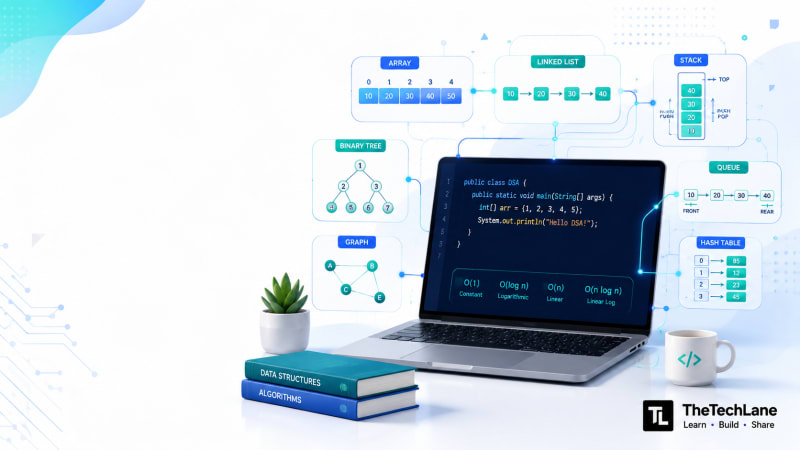
Data Structures and Algorithms (DSA) for Beginners
If you want to become a software developer, crack coding interviews, or improve your problem-solving skills, Data Structures and Algorithms (DSA) is one of the most important topics to learn.
At first, DSA can seem confusing because of terms like arrays, linked lists, trees, graphs, and time complexity. The good news is that these concepts become much easier when you understand them step by step.
In this guide, you'll learn what DSA is, why it matters, the most common data structures and algorithms, and the roadmap every beginner should follow.
What is Data Structures and Algorithms (DSA)?
Data Structures and Algorithms (DSA) is a fundamental concept in computer science that helps us store, organize, and process data efficiently.
It consists of two parts:
Data Structure: A way to organize and store data.
Algorithm: A step-by-step process to solve a problem.
Think of it this way:
Imagine a library.
The bookshelves organize thousands of books so they are easy to find. That's a data structure.
The method you use to locate a book, such as searching by title or category, is an algorithm.
A good data structure combined with the right algorithm makes programs faster and more efficient.
Why Should You Learn DSA?
Learning DSA is about much more than passing coding interviews.
It helps you write better code, solve problems logically, and build applications that perform well even when they handle large amounts of data.
Here are some of the biggest benefits:
Improves problem-solving skills
Helps write faster and more efficient programs
Builds a strong programming foundation
Prepares you for technical interviews
Makes learning advanced programming concepts easier
Whether you're building a website, a mobile app, or software for a large company, DSA plays an important role behind the scenes.
What is a Data Structure?
A data structure is a way of storing data so that it can be accessed and managed efficiently.
Different problems require different ways of organizing data.
For example, a shopping app stores products, users, and orders. A navigation app stores maps and routes. A social media platform stores posts, comments, and friendships. Each of these uses different data structures depending on the problem it needs to solve.
Some of the most common data structures include:

Each data structure has its own strengths and limitations.
What is an Algorithm?
An algorithm is a sequence of steps used to solve a problem.
Just like following a recipe to cook a meal, a computer follows algorithms to complete tasks.
For example, when you search for a contact on your phone, your device uses an algorithm to find the correct result quickly.
Algorithms are used everywhere, including:
Searching data
Sorting information
Finding the shortest path on maps
Recommending videos on YouTube
Displaying search results on Google
The better the algorithm, the faster the program performs.
Difference Between Data Structures and Algorithms
Many beginners confuse these two terms.
Here's an easy way to understand the difference.

In simple words:
Data structures store data, while algorithms work on that data.
Common Data Structures Every Beginner Should Learn
Array
An array stores multiple values in a fixed order.
Arrays are simple, fast, and commonly used in almost every programming language.
Example:
10 20 30 40 50Arrays provide fast access to elements using their index.
Linked List
A linked list stores data using connected nodes instead of continuous memory.
It is useful when data changes frequently through insertions and deletions.
Stack
A stack follows the Last In, First Out (LIFO) principle.
Imagine a stack of books. The last book placed on top is the first one removed.
Common uses include:
Undo feature
Browser history
Function calls
Queue
A queue follows the First In, First Out (FIFO) principle.
Think of people standing in a ticket queue. The first person to enter is the first person served.
Queues are used in:
Printer jobs
CPU scheduling
Online ticket booking systems
Tree
A tree organizes data in a parent-child relationship.
Trees are widely used in:
File systems
Database indexing
Search engines
Graph
A graph represents connections between objects.
Examples include:
Google Maps
Facebook friendships
Flight routes
Computer networks
Graphs help solve problems involving relationships and navigation.
What are Algorithms?
Algorithms tell the computer how to solve a problem.
Some of the most popular algorithms include:
Searching Algorithms
Searching algorithms find an element from a collection.
Examples:
Linear Search
Binary Search
Sorting Algorithms
Sorting algorithms arrange data in ascending or descending order.
Common sorting algorithms include:
Bubble Sort
Selection Sort
Insertion Sort
Merge Sort
Quick Sort
Each algorithm has its own advantages depending on the situation.
What is Time Complexity?
When learning DSA, you'll often hear about time complexity.
Time complexity measures how the running time of an algorithm changes as the amount of data increases.
For example, searching for a name in a list of 10 people is much faster than searching through 1 million names.
Some algorithms grow slowly as data increases, while others become much slower.
That's why choosing the right algorithm is important.
Some common time complexities are:
🟢 O(1) – Constant Time : Excellent performance. The execution time stays the same regardless of the input size.
🟢 O(log n) – Logarithmic Time : Very fast. The execution time increases slowly even when the input becomes much larger.
🟡 O(n) – Linear Time : Good performance. The execution time grows in proportion to the input size.
🟡 O(n log n) – Linearithmic Time : Efficient for large datasets and commonly used in sorting algorithms like Merge Sort and Quick Sort.
🔴 O(n²) – Quadratic Time : Slow for large datasets because the execution time increases rapidly as the input size grows.
As a beginner, don't worry about memorizing these immediately. Focus on understanding the idea that some solutions are more efficient than others.
DSA Roadmap for Beginners
If you're just starting, learn topics in this order:
Arrays
Strings
Searching
Sorting
Linked Lists
Stacks
Queues
Hash Tables
Trees
Graphs
Recursion
Dynamic Programming
Don't rush to advanced topics. Build a strong foundation first.
Final Thoughts
Data Structures and Algorithms are the backbone of programming. They help you organize data efficiently, solve problems faster, and write better code.
At first, DSA may seem challenging, but every experienced developer started with the basics. Learn one concept at a time, practice regularly, and focus on understanding why a solution works instead of memorizing it.
With consistent practice, you'll become more confident in solving coding problems and be well-prepared for software development and technical interviews.
Key Takeaways
DSA stands for Data Structures and Algorithms.
Data structures organize data, while algorithms solve problems.
Arrays, linked lists, stacks, queues, trees, and graphs are essential data structures.
Searching and sorting are the first algorithms every beginner should learn.
Time complexity helps compare the efficiency of different solutions.
Learning DSA step by step builds a strong programming foundation.
Have a Question?
If you have any questions about DSA or programming, leave a comment below. We'll be happy to help.
Follow TheTechLane
Want more Java tutorials, programming tips, and developer resources?
Follow TheTechLane on LinkedIn, X, Instagram, Threads, and Pinterest to stay updated whenever a new tutorial is published.
Learn. Build. Share.
— TheTechLane
Related reading: DSA for AI engineers, Java vs Python, and what Java is.