Gemini 4 Carbon Is Open to All Paid Devs. Will Your Bill Double?
Google opened Gemini 4 Carbon to all paid API users at $2/$10 per M tokens, but prices double Dec 1. Here's what to change in your code and when to keep Argon.
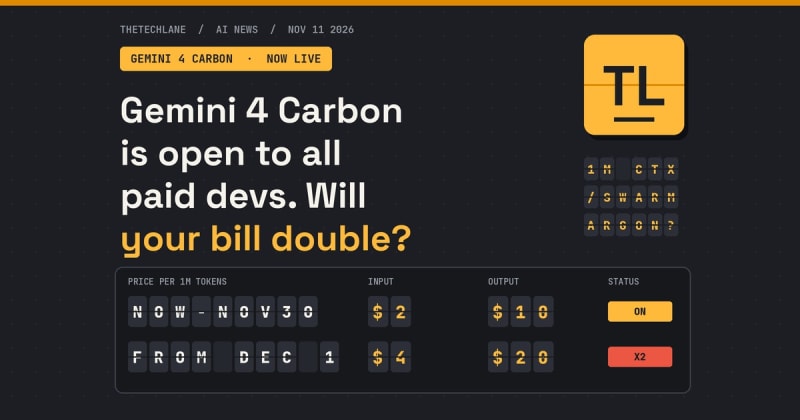
Google made Gemini 4 Carbon, its strongest model, available to every paying Gemini API developer on Tuesday, November 10, 2026, at an introductory $2 per million input tokens and $10 per million output tokens. That's roughly a quarter of Claude Fable 5.2's list price. The catch: the deal ends on November 30, and from December 1 the same tokens cost twice as much.
Here's what you need to know:
Gemini 4 Carbon (
gemini-4-carbon) is live on the paid tier of the Gemini API in Google AI Studio and Android Studio, in Gemini for business, and for Google AI Ultra subscribers in Antigravity, the Gemini app and AI Mode in Search.Pricing is $2 input and $10 output per million tokens through November 30, then $4 and $20. Thinking tokens are billed as output, and Carbon isn't on the free tier.
It has a 1,048,576-token unified context window, three thinking levels (
low,mediumby default,high) and long decode that can push one response past 64K tokens.Google still says Gemini 4 Argon is the right pick for most coding and knowledge work. Carbon is for the hardest, longest jobs, and it burns more thinking tokens doing them.
Google is also previewing
/swarmin Antigravity, which turns one prompt into a coordinated team of agents.
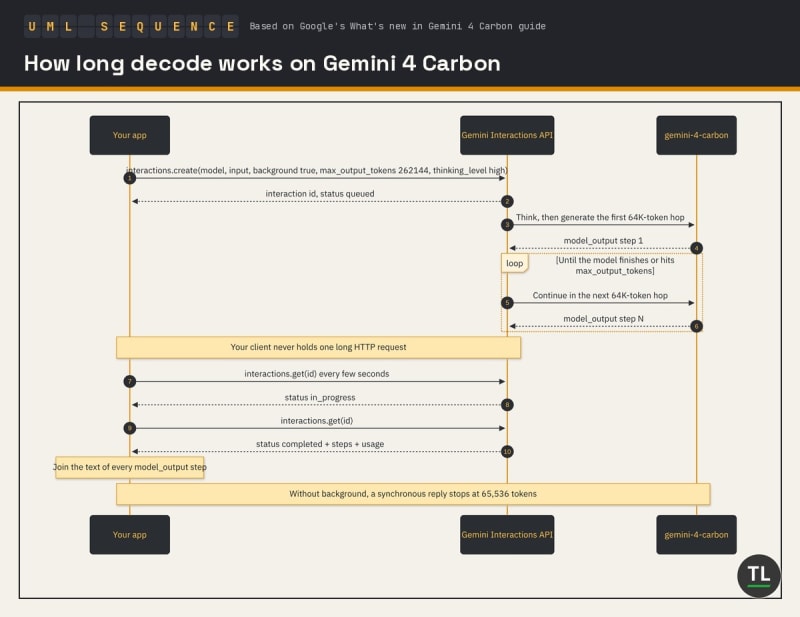
How long decode works on Gemini 4 Carbon with background execution
What Happened
Two weeks ago, Carbon was only in the hands of vetted security teams. As we reported at the time, Google first released it through its Fairwind Program for cybersecurity defenders. On November 10, Google DeepMind's Koray Kavukcuoglu announced in Google's "Gemini 4 Carbon is now available" post that the general-use model is now open to developers, enterprises, scientists and consumers.
Google calls Carbon its "strongest model" for cybersecurity and long-horizon agentic work. It's careful to position it next to, not above, Argon in daily use. In Google's words, "Argon remains the ideal choice for the majority of software engineering and knowledge work," while Carbon is built for "complex, multi-step coding and debugging and open-ended scientific research," and it uses more tokens than Argon to "explore thoroughly, reason deeply, and run extended verification loops."
The developer announcement points builders to the paid Gemini API in AI Studio and Android Studio. Google's What's new in Gemini 4 Carbon guide fills in the details: model ID gemini-4-carbon, a default thinking level of medium, and the same per-token price as Argon.
The Gemini 4 Carbon model page lists text, image, video, audio and PDF inputs with text output. It supports function calling, structured outputs, code execution, computer use, file search and Google Search grounding. Synchronous responses stop at 65,536 output tokens by default, but long decode can stretch a single answer toward the full 1M window.
Google's headline benchmark claim is that Carbon ranks No. 1 on CursorBench 4.0, Perplexity's WANDR and Zapier's AutomationBench "at more than 2X lower cost per task" than the next best external model. Be careful with that one. VentureBeat's analysis found that Zapier's public table backs Google up (Carbon high scored 53.88% at about $2.12 per task, ahead of Fable 5.2 max at 51.45% and $4.64), but the public CursorBench and WANDR tables it reviewed had no Carbon row, so those two claims are still unverified.
On the broad Artificial Analysis Intelligence Index, VentureBeat reports Fable 5.2 at 65, Carbon at 60 on high, Claude Opus 5.5 at 59 and OpenAI's GPT-6 Astra at 57. Carbon debuted in first place in October. Anthropic's model launched a day before this rollout and took the top spot. We broke down that launch in our Claude Fable 5.2 migration guide.
Consumers get it too. 9to5Google reports that the Gemini app now labels Carbon "Most complex work" in the model picker, keeps Argon for "Code & analysis," and has dropped 3.1 Pro.
Why It Matters
The frontier race is now a price war as much as a benchmark war. The Verge notes that Carbon's launch price is around a fifth of GPT-6 Astra's and a quarter of Fable 5.2's. Even after it doubles, Carbon's $4 and $20 matches Claude Opus 5.5 and is still half of Fable 5.2's $8 and $40.
But per-token price isn't what you pay per finished job. Artificial Analysis estimates an average of $7.76 per task for Carbon on high across its index suite, against $26.54 for Fable 5.2 at maximum effort. Fable at high effort costs $9.08 and scores two points higher. At medium effort, Fable is cheaper per task ($3.80 against $6.59) while Carbon scores higher (58 against 56), according to VentureBeat. The cheapest model on paper isn't always the cheapest model in your logs.
Coding results split by task, too. Carbon high leads on Terminal-Bench 4.0 with 65.2% against Fable's 61.6%. On FrontierCode 2.0, which grades real repository changes against merge standards, Fable scores 49.1% and Carbon 40.6%. A team running terminal-heavy diagnostics might pick Carbon. A team that wants more patches through code review might not.
Safety is part of the pitch. Google says that in simulated cyberattack testing, Carbon's safeguards blocked 99% of attack trajectories from an adaptive red-teaming agent and cut the per-attempt breach rate to 0.8%, down from 3.1% on Argon. On Google's 375-task agentic honesty benchmark, it passed 92% of tasks against 70% for Argon. These are Google's own numbers, and the full Fairwind cyber variant stays gated.
What It Means for Developers
If you already call gemini-4-argon, the switch is small. Google's migration checklist says it "requires no request schema changes." Change the model string and give Carbon room to think. Here's a minimal Python call, adapted from Google's guide:
from google import genai

client = genai.Client()
interaction = client.interactions.create(
    model="gemini-4-carbon",
    input="Find the race condition in this retry loop and fix it.",
    generation_config={"thinking_level": "medium"},
)
print(interaction.output_text)
Coming from Gemini 3 or earlier? There's more to check:
Raise
max_output_tokens. Google recommends at least 32,768, because Carbon can spend more of the limit on thinking. The cap covers thinking plus output combined.Drop explicit context caching.
cachedContentsandcaches.createaren't supported on Carbon. Implicit caching kicks in from 4,096 prompt tokens and discounts cached input by 95%, to $0.10 per million now and $0.20 from December 1.Delete
temperature,top_pandtop_k. Carbon ignores them.Stretch your timeouts. Google says hard prompts "can take several minutes" and recommends background execution or HTTP client timeouts of at least 15 minutes.
Use background mode for big outputs. Set
backgroundto true andmax_output_tokensabove 65,536, and the server generates the reply in 64K-token hops. Join the text from everymodel_outputstep at the end.Keep state on the server. Use
previous_interaction_idfor multi-turn and function-calling flows.Budget for December now. Re-run your cost model at $4 and $20, and remember that grounding with Google Search is billed per query on top.
If you route through a gateway, LiteLLM shipped day-zero support as gemini/gemini-4-carbon. It maps its reasoning_effort setting to Carbon's thinking level and lists Batch and Flex pricing at $1 and $5 per million tokens.
The practical play is to treat Carbon as a specialist. Keep Argon (or your current model) as the baseline, then send Carbon the jobs that already eat engineer hours, such as cross-repo migrations or root-cause hunts, and measure spend, latency and reviewer time side by side. If you're building agents that call tools, our MCP Part 1 tutorial shows how to wire up the tool side.
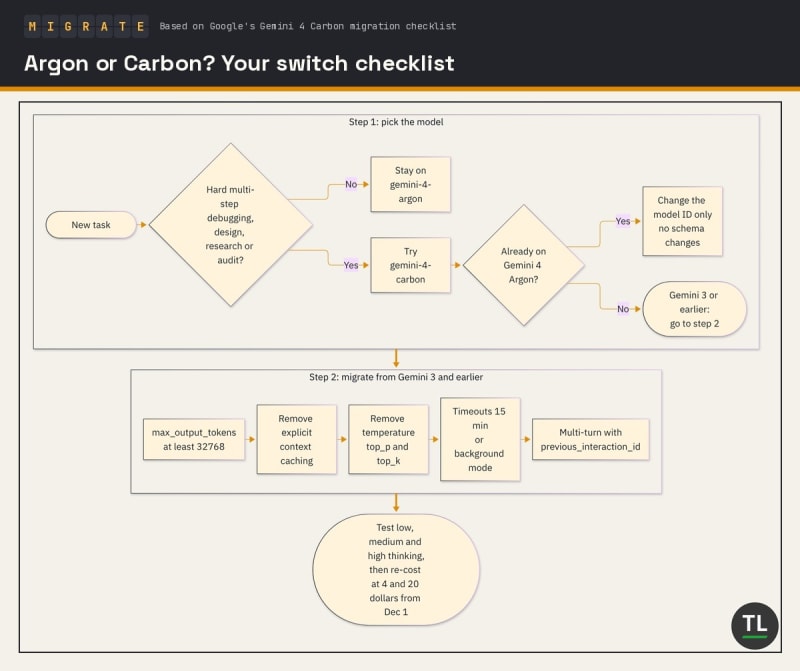
Argon or Carbon? Your Gemini 4 Carbon switch checklist
What's Next
The clock is the big story. You've got until November 30 to test Carbon at half price. After that, the $4 and $20 rates apply to the public Carbon model.
Watch the /swarm preview in Antigravity. Google pitches it as a way to put Carbon on architecture, coordination and audit roles while lighter, faster models do the parallel implementation work in isolated workspaces, with adversarial verifiers testing every change. That's a cost play as much as a capability one.
Some questions are still open. Google hasn't published a country-by-country rollout schedule. VentureBeat also points out that the rollout materials leave Vertex AI availability, regions and support commitments unspecified, which matters if you buy through a cloud contract. And Google hasn't released the score and cost figures behind its CursorBench and WANDR claims.
Expect quick replies from rivals, too. Anthropic shipped Fable 5.2 the day before, and with prices this close, the next move could come any week.
FAQ
Is Gemini 4 Carbon free to try?
Not through the API. Carbon isn't available on the Gemini API free tier, so you need a paid key. Google AI Ultra subscribers can try it in the Gemini app, AI Studio and Antigravity.
Should I replace Gemini 4 Argon with Carbon?
Usually not. Google itself recommends Argon for most coding and knowledge work because it's faster and spends fewer tokens per turn. Use Carbon for the hardest multi-step debugging, design and research tasks.
How much will Gemini 4 Carbon cost after November 30?
From December 1, 2026, it costs $4 per million input tokens and $20 per million output tokens, including thinking tokens. Cached input rises from $0.10 to $0.20 per million.
Want the next model launch explained before your standup? Subscribe to the free TheTechLane newsletter for developer-focused AI news, migration checklists and tutorials, straight to your inbox.
Sources
Gemini 4 Carbon is now available, Google
What's new in Gemini 4 Carbon, Gemini API docs
Gemini 4 Carbon model page, Gemini API docs
Gemini 4 Carbon model card, Google DeepMind
Google Gemini 4 Carbon is now publicly available and undercuts Claude Fable 5.2 on API price, VentureBeat
Google releases Gemini 4 Carbon with agent swarm feature, The Verge
Gemini 4 Carbon rolling out to Gemini app for AI Ultra, 9to5Google
Follow TheTechLane
Keep learning AI, development, and modern developer technologies with TheTechLane.
Learn • Build • Share
Follow @thetechlanehq for more developer guides, tutorials, and practical technology content.