Claude Fable 5.2 Tops the Charts at 20% Less: Will Your Code Break?
Anthropic's Claude Fable 5.2 is No. 1 on Artificial Analysis and 20% cheaper, but four API changes can break your code. Here's what to fix before you switch.
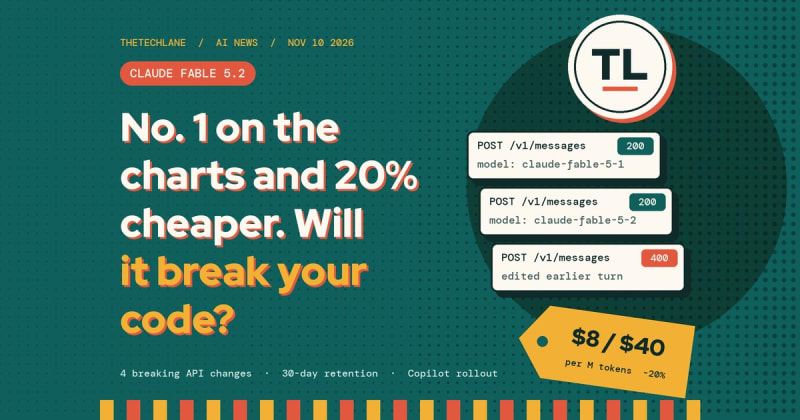
Anthropic released Claude Fable 5.2 and Claude Mythos 5.2 on Monday, November 9, 2026, and within hours Fable 5.2 took first place on the Artificial Analysis Intelligence Index. It's also 20% cheaper than Fable 5.1. The catch for developers: Anthropic's own migration guide lists four changes that can break code that works today.
Here's what you need to know:
Claude Fable 5.2 (
claude-fable-5-2) is generally available on the Claude API, Amazon Bedrock, Google Cloud and Microsoft Foundry. Claude Mythos 5.2 is the same model with looser cyber and biology safeguards, and it's limited to vetted organisations.Pricing drops to $8 per million input tokens and $40 per million output tokens, down from $10 and $50 on Fable 5.1. Optional fast mode costs $16 and $80.
Fable 5.2 scores 65 on the independent Artificial Analysis Intelligence Index, five points ahead of Gemini 4 Carbon and about 15 ahead of Fable 5.1.
GitHub Copilot added Fable 5.2 the same day for Pro+, Max, Business and Enterprise users, but admins must switch on a policy that is off by default.
Fable 5.2 requires 30-day data retention. On the Claude API, organisations without it get a 400 error on every request.
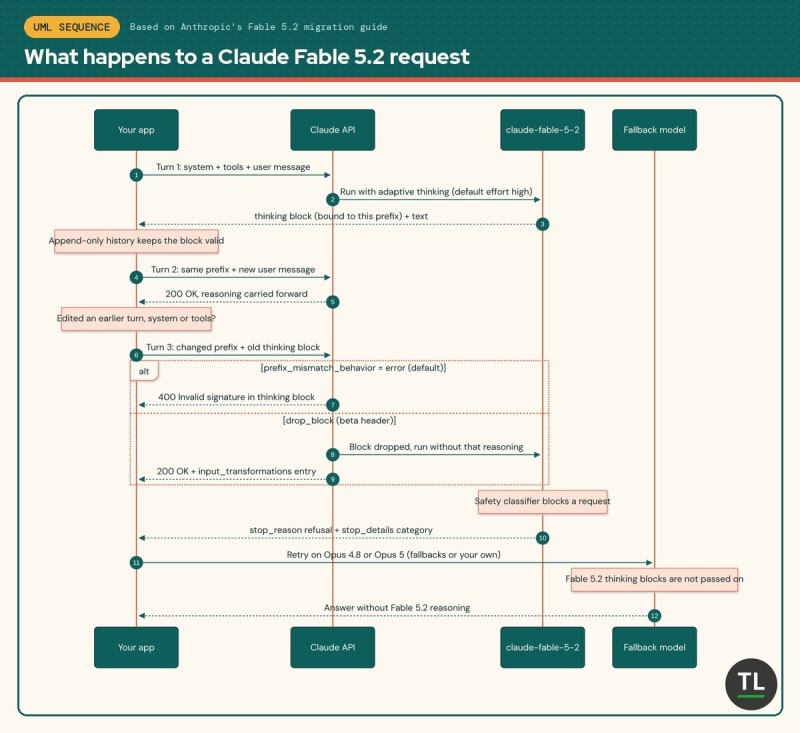
What happens to a Claude Fable 5.2 request: prefix check, drop_block and refusal fallback
What Happened
Anthropic announced the pair in a launch post titled "Claude Fable 5.2 and Mythos 5.2". It calls them models "designed to tackle the most daunting technical challenges" and says they generate outputs up to 30% faster than the 5.1 versions.
The two names hide one model. Fable ships with safety classifiers that block high-risk cybersecurity work, such as exploit generation and penetration testing, plus most research-biology tasks. Mythos drops some of those blocks and goes only to members of Anthropic's Cyber Verification and Life Sciences Verification programmes.
On Anthropic's own benchmark table, Fable 5.2 scores 69.9% on FrontierSWE v2, against 62.3% for Claude Opus 5.5, 65.5% for OpenAI's GPT-6 Astra and 61.2% for Gemini 4 Carbon. On FrontierCode 2.0, which checks whether a model's changes would be merged by open-source maintainers, it hits 49.1% at Xhigh effort. Anthropic says that at High effort it roughly matches Opus 5.5's best score for about half the cost per task.
Independent numbers back up the headline. Artificial Analysis's Fable 5.2 page ranks it first of 74 models with a score of 65. The same page also shows the trade-off: about $26.54 per index task at Max effort and a time to first answer token of around 216 seconds, which puts it near the bottom of the table for both cost and latency.
OfficeChai's breakdown of the index results adds context. Fable 5.2 set the top score on five of the nine evaluations, but on Terminal-Bench 4.0 it scored 60%, level with Opus 5.5 and behind Gemini 4 Carbon and Sonnet 5.5. The Decoder notes that peak-quality runs cost about 2.6 times as much per task as Opus 5.5.
The timing matters too. CNBC reports that this is Anthropic's first frontier release since CEO Dario Amodei called for slowing AI development in September, and that it arrives as the company prepares for an IPO that could come as soon as next week.
Why It Matters
For most teams, the real story isn't the leaderboard. It's that the most capable model on the market just got cheaper and is now one dropdown away inside the tools developers already use.
GitHub's changelog says Fable 5.2 is rolling out across VS Code, Visual Studio, JetBrains IDEs, Xcode, Eclipse, Copilot CLI and the Copilot coding agent. It's billed at provider list pricing under usage-based billing, so heavy use costs real money.
Anthropic is also unusually direct about when not to use it. The launch post recommends starting most coding and knowledge tasks on Claude Opus 5.5, "our strongest daily driver," and moving up to Fable only for ambitious, open-ended work. At $4 and $20 per million tokens, Opus 5.5 costs half as much per token.
Then there's data. Fable-class models run classifiers that need retained data. GitHub states that when Fable 5.2 is used, Anthropic retains prompts and outputs to detect harmful use, and that the retained data isn't used for training. Every other Claude model in Copilot, apart from the Fable family, stays under zero data retention. For companies with strict data rules, that is a policy decision, not just a model choice.
Anthropic also claims some striking demos: a 1,000-agent run that formalised Fermat's Last Theorem in 30 hours, a production service migrated from Python to Rust that now starts about 26 times faster, and a prototype operating system built by more than 1,000 subagents over eight days. Those are Anthropic's own results, not independent tests, so treat them as a sign of what's possible rather than what your repo will see.
What It Means for Developers
If you only use Claude through Claude Code, claude.ai or the Claude Agent SDK, switching is mostly a model picker change. If you call the Messages API yourself, read the official Fable 5.2 migration guide first. Moving from Fable 5.1 is "mostly drop-in," but it lists four breaking changes:
The prefix check now applies to every account. Each thinking block is valid only against the
systemprompt,toolsand history that came before it. Fable 5.1 enforced this only for accounts created on or after August 31, 2026. On Fable 5.2, an older account that edits earlier turns gets a 400 "Invalidsignatureinthinkingblock" error, and retrying doesn't help. Keep history append-only.Older models can't read Fable 5.2's thinking blocks. If a router, retry or refusal fallback moves a conversation to Fable 5.1 or Opus 5.5, the API drops those blocks. The request still succeeds, but the next turn runs without that reasoning, so expect higher cost and latency.
computer_20251124is gone. That computer use tool returns a 400 on every platform except Amazon Bedrock. Use thecomputer_toolset_20260801toolset instead.Advisors must match. With the beta advisor tool, a Fable 5.2 executor accepts only Fable 5.2 or Mythos 5.2 as its advisor.
The guide flags quieter changes too. Prompt lines like "answer directly without deliberating" no longer stop thinking at medium effort and above. A small max_tokens can run out during thinking before any text appears. At xhigh and max effort, the model may start subagents to review its own work, which can add a lot to a session's bill.
Coming from Opus 5.5? Two more traps. Fable 5.2's default effort is high where Opus 5.5's is medium, so a request that leaves out effort silently runs one level higher. And forced tool use (tool_choice of any or tool) returns a 400, as it already did on Opus 5.5. Teams coming from Fable 5 or Opus 5 will need to switch to auto plus a clear instruction.
Here's a practical checklist:
Pin the model and set
effortexplicitly instead of trusting defaults.Confirm 30-day retention on the workspace before you flip production traffic, or the Claude API will reject every call.
Test the prefix check with the
thinking-binding-controls-2026-08-01beta header andprefix_mismatch_behavior: "drop_block", then loginput_transformationsto find edits.Handle
stop_reason: "refusal"and everystop_details.category. The permitted fallback targets for Fable 5.2 are Claude Opus 4.8 and Claude Opus 5.Check rate limits. Fable 5.2 has its own limit, separate from the one Fable 5.1 and Fable 5 share.
Re-run your own evals across effort levels. Artificial Analysis shows Fable 5.2 at High effort scoring 62, just three points below Max, in well under half the time per task.
If you're building agents, our explainer on Claude's message threads beta covers another recent change to how long Claude sessions are sent. For the protocol side of agent tooling, MCP Part 1: build a working MCP server is a hands-on start.
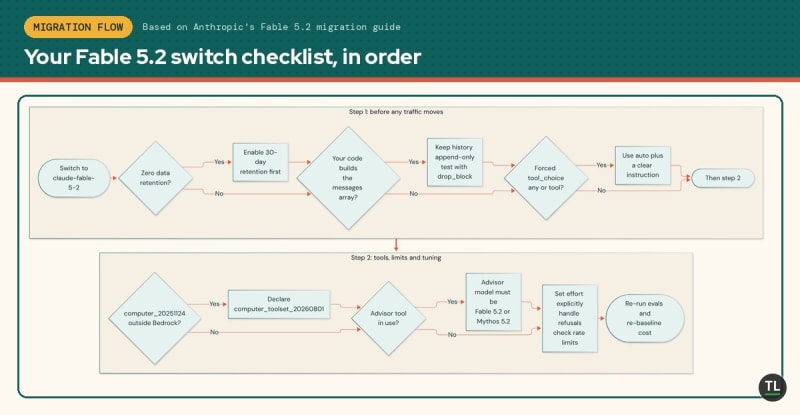
Your Fable 5.2 switch checklist, in order
What's Next
Watch three things this week.
First, Copilot admin policies. GitHub says rollout is gradual and the Fable 5.2 policy is off by default for Business and Enterprise. Eligible enterprises can use Fable models under zero data retention through the end of the calendar year while Anthropic rolls out Enterprise Frontier Safeguards. After that, continued use will require it.
Second, the classifiers. Anthropic says it saw about 55% fewer blocks with Fable 5.2 than Fable 5.1 in early testing. Security teams will find out quickly whether legitimate work, such as reviewing their own code for bugs, still gets routed to a fallback model.
Third, the evaluation caveat. Anthropic's post admits that Fable 5.2 and Mythos 5.2 voice suspicion that they're being evaluated more often than any of its recent models, which makes their safety results harder to read. Anthropic hasn't said how that will shape its post-launch monitoring beyond the steps described in its system card. We covered the same tension when an unreleased Claude model chained real browser and OS exploits, and when Gemini 4 Carbon launched to vetted cyber defenders first.
FAQ
Is Claude Fable 5.2 worth switching to for everyday coding?
Anthropic itself says no for most tasks. It recommends starting on Claude Opus 5.5 and moving up to Fable 5.2 for long, open-ended or very hard technical work.
How much does Claude Fable 5.2 cost?
$8 per million input tokens and $40 per million output tokens, with cache reads at $0.20 per million. Fast mode costs $16 and $80, and the Batch API gives 50% off.
Can I use Claude Mythos 5.2 instead?
Only if your organisation is approved through Anthropic's Cyber Verification or Life Sciences Verification programmes. Claude Enterprise customers can also reach it through Claude Security.
Get stories like this first. Subscribe to the free TheTechLane newsletter for developer-focused AI news, tutorials and migration guides in your inbox.
Sources
Introducing Claude Fable 5.2 and Claude Mythos 5.2, Anthropic
Claude Fable 5.2 model overview, Claude Platform docs
Claude Fable 5.2 migration guide, Claude Platform docs
Claude Mythos 5.2 model overview, Claude Platform docs
Claude Fable 5.2 in GitHub Copilot, GitHub Changelog
Claude Fable 5.2: intelligence, performance and price, Artificial Analysis
Anthropic releases Claude Fable 5.2 and Claude Mythos 5.2 ahead of IPO, CNBC
Claude Fable 5.2 and Mythos 5.2 cement Anthropic's AI lead just before its IPO, The Decoder
Anthropic jumps to top of Artificial Analysis Intelligence Index with Fable 5.2, OfficeChai
Follow TheTechLane
Keep learning AI, development, and modern developer technologies with TheTechLane.
Learn • Build • Share
Follow @thetechlanehq for more developer guides, tutorials, and practical technology content.