ChatGPT Agents Explained: The Biggest AI Shift Since ChatGPT
Discover what ChatGPT Agents are, how they work, real-world use cases, benefits, limitations, and why AI agents are transforming the future of work.

Artificial intelligence is evolving faster than ever. Just a few years ago, AI chatbots amazed people by answering questions and generating content. Today, the next evolution has arrived: AI agents.
Unlike traditional AI chatbots that simply respond to prompts, AI agents can plan tasks, make decisions, use tools, browse the web, write code, analyze files, and complete multi-step workflows with minimal human input.
This shift is changing how businesses operate, how developers build software, and how professionals automate their daily work. If ChatGPT introduced conversational AI to the world, AI agents are introducing autonomous AI.
In this guide, we'll explain what AI agents are, how they work, where they're already being used, and why many experts consider them the next major leap in artificial intelligence.
What Is an AI Agent?
An AI agent is an intelligent system designed to achieve a goal rather than simply answer a question.
Instead of waiting for every instruction, an AI agent can break a task into smaller steps, determine what information it needs, use available tools, evaluate progress, and continue working until the objective is completed.
Think of it like the difference between asking someone for directions and hiring someone to complete an entire project for you.
For example, instead of asking:
"Find the cheapest laptop."
You could tell an AI agent:
"Research the best laptops under $1,000, compare reviews, summarize the pros and cons, and recommend the best option."
The agent performs multiple actions automatically.
How AI Agents Work
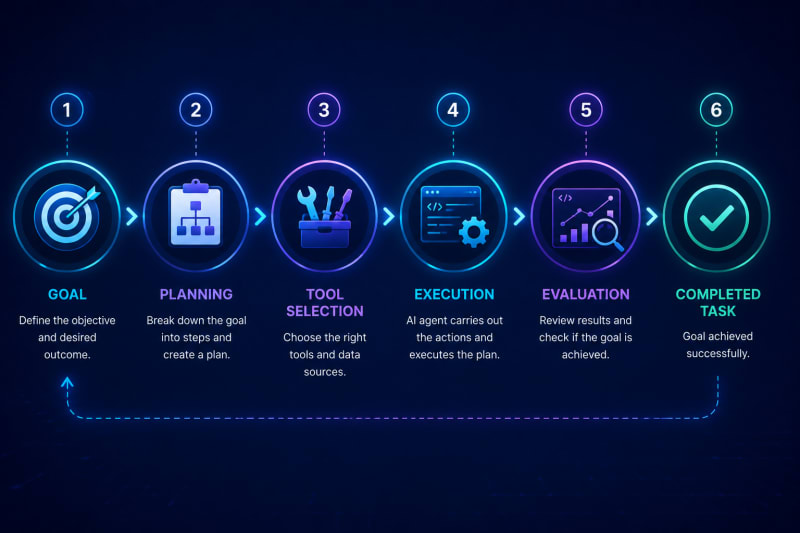
Most AI agents follow a structured workflow:
Understand the user's objective.
Create a plan to achieve it.
Select the appropriate tools.
Execute each task.
Evaluate the results.
Repeat if necessary until the goal is completed.
This process makes AI agents far more capable than traditional chatbots.
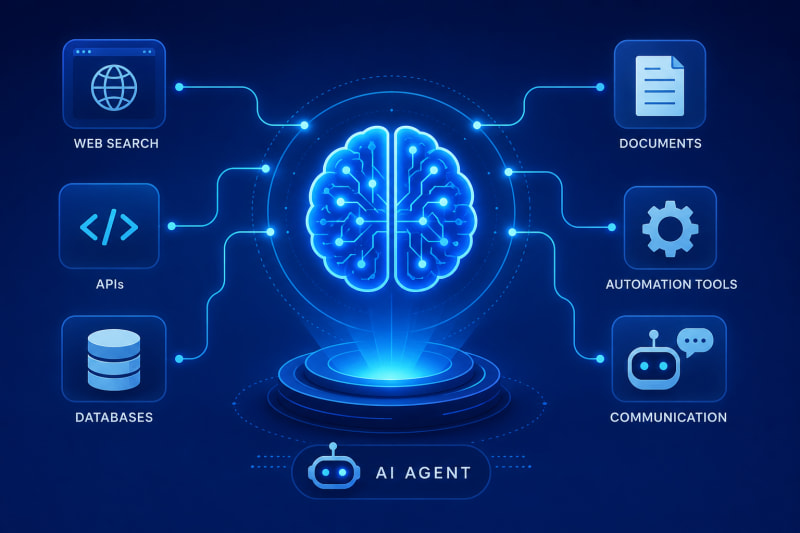
Many modern agents can combine language models with web browsing, databases, APIs, document analysis, code execution, and automation tools.
Why AI Agents Matter
AI agents reduce repetitive work and increase productivity.
Instead of manually researching information, writing reports, organizing files, or comparing products, users can delegate these tasks to an intelligent assistant.
Businesses are already using AI agents to:
Automate customer support
Analyze business data
Generate reports
Assist software developers
Manage documentation
Improve marketing workflows
Conduct market research
As these systems improve, they'll become digital teammates rather than simple assistants.
Real-World Applications
Software Development
Developers use AI agents to generate code, debug applications, explain unfamiliar codebases, write documentation, and automate testing.
Rather than switching between multiple tools, developers can complete complex workflows through a single intelligent assistant.
Content Creation
Marketing teams use AI agents to research topics, create outlines, optimize articles for SEO, generate social media content, and repurpose long-form content into newsletters or videos.
Human editing remains essential, but AI significantly accelerates production.
Business Operations
Companies use AI agents to summarize meetings, organize documents, automate repetitive workflows, prepare presentations, and analyze spreadsheets.
This allows employees to spend more time on strategic work.
Customer Service
Modern AI agents can understand customer questions, search knowledge bases, recommend solutions, and escalate only complex cases to human representatives.
This improves response times while reducing operational costs.
Benefits of AI Agents
AI agents provide several advantages:
Faster task completion
Higher productivity
Better information retrieval
Reduced repetitive work
Continuous availability
Improved decision support
Easier workflow automation
Rather than replacing professionals, AI agents are becoming productivity multipliers.
Current Limitations
Despite impressive capabilities, AI agents are not perfect.
They can still:
Misinterpret objectives
Produce incorrect information
Make reasoning mistakes
Depend on outdated data without web access
Require human verification for critical decisions
Organizations should treat AI agents as powerful assistants rather than completely autonomous decision-makers.
Human oversight remains essential, especially in healthcare, finance, law, and other high-risk industries.
The Future of AI Agents
The next few years will likely see AI agents becoming deeply integrated into everyday software.
Instead of opening separate applications for email, spreadsheets, coding, research, and scheduling, users may simply assign a goal to an AI agent and let it coordinate everything.
Future agents will likely:
Collaborate with other AI agents
Remember long-term project context
Handle increasingly complex workflows
Work securely across enterprise systems
Become standard features in productivity software
This evolution could fundamentally change how knowledge work is performed.
Should You Learn AI Agents?
Absolutely.
Whether you're a developer, entrepreneur, marketer, student, or business owner, understanding AI agents is becoming an increasingly valuable skill.
Learning how to collaborate effectively with AI systems may soon become as important as learning how to use spreadsheets or search engines.
Those who adapt early will likely gain a significant productivity advantage.
Final Thoughts
AI agents represent one of the biggest shifts in artificial intelligence since conversational AI became mainstream.
Rather than acting as passive chatbots, these systems can plan, execute, and refine complex tasks using multiple tools and information sources.
While they still require human oversight, their ability to automate workflows and assist with real-world work is already transforming industries.
As AI continues to evolve, agents are expected to become an essential part of modern business, software development, and everyday productivity. Understanding how they work today will help individuals and organizations prepare for the next generation of intelligent computing.
Continue Reading on TechLane
If you're interested in AI, developer tools, and the future of software engineering, check out these in-depth guides:
Build Your First MCP Server: A Hands-On Tutorial
Learn how to build your own Model Context Protocol (MCP) server using Python, create custom tools, and test them with MCP Inspector.AI Coding Agents in 2026: How Agentic AI Is Changing Software Development
Discover how AI coding agents can inspect repositories, write code, fix bugs, run tests, and automate development workflows.Model Context Protocol (MCP) Explained: The Complete Developer Guide
Understand what MCP is, how clients and servers communicate, and why it is becoming the standard protocol for AI-powered applications.
Follow TheTechLane
Want more developer tutorials, programming tips, and tech updates?
Follow TheTechLane on LinkedIn, X, Instagram, Threads, and Pinterest to stay connected and catch new tutorials when they go live.
Learn. Build. Share.
— TheTechLane