Can You Trust an AI-Built Database? Jepsen Found 96 Bugs in ParticleDB
Jepsen found 96 bugs in ParticleDB, an AI-focused database built with LLM help, and told users to stop deploying it. Here's what broke and why it matters.
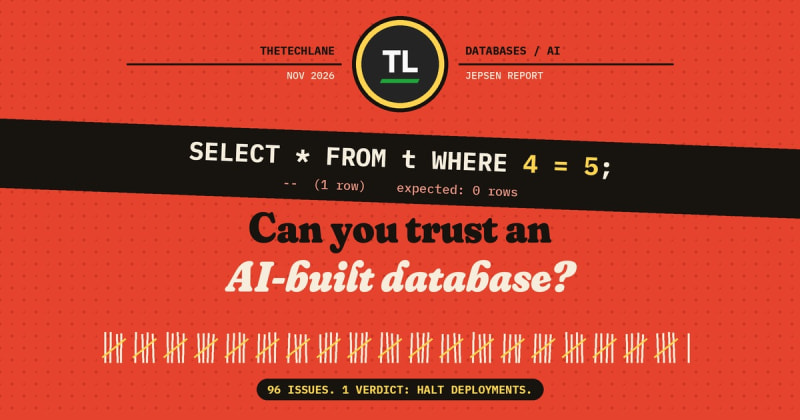
Database testing outfit Jepsen has told users to "halt further deployment of ParticleDB and migrate to other databases as soon as possible" after finding 96 issues in the AI-focused database, which its makers built with help from large language models. The October 31 report reads like a warning label for the whole industry.
Here's what you need to know:
Jepsen tested ParticleDB 1.1.4 through 1.1.18.11.rc-22 and logged 96 issues, from lost writes to
WHERE 4 = 5returning rows.All but three of those issues showed up on a healthy, single-node server with no injected faults.
Jepsen says "LLM tooling repeatedly claimed that bugs had been fixed when, in fact, they had not."
Maker Orkes says version 1.1.19-rc.13 fixes the remaining issues, but Jepsen hasn't tested anything after rc-22.
The work was funded by Orkes itself, under Jepsen's ethics policy.
What Happened
ParticleDB is a multi-model database from Orkes, the company behind the Conductor workflow orchestration platform. It's written in Rust, speaks the Postgres and Redis protocols, and pitches transactional SQL, key-value storage, vector search and live analytics in one engine "with a special focus on AI agents and applications."
In Jepsen's ParticleDB 1.1.4 analysis, published October 31, Kyle Kingsbury tested single-node builds on Debian 13 and found 96 issues "ranging from the pedestrian (crashes, deadlocks, data loss, etc.) to the piquant." Some highlights:
SELECT * FROM t WHERE 4 = 5returned the row with primary key 5.NOT NULLandUNIQUEconstraints were ignored in early builds, leaving rows thatCOUNT(*)could see butSELECT *could not.Strings were sometimes returned as 8-bit integers, and primary keys could become null.
In later builds, out of roughly 20,000 keys in one test, 31 lost acknowledged writes in normal operation.
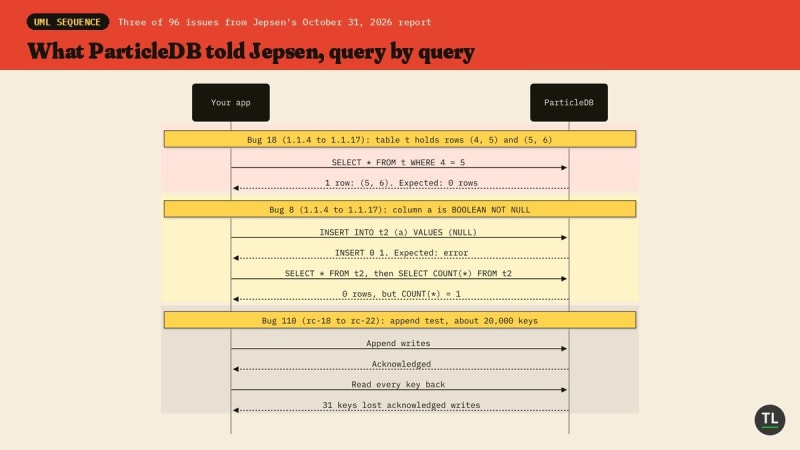
Three of Jepsen's 96 ParticleDB findings, query by query
The marketing didn't match. Jepsen says ParticleDB's home page claimed "Full ACID. 159K TPS." and a TLA+ proof, yet no TLA+ specification was available during testing. It also advertised being "1087x faster than PostgreSQL," but Jepsen saw nothing near that and recorded throughput declining over an hour.
Jepsen's verdict on the documentation was blunt: it was "riddled with omissions, inconsistencies, and confabulations." The Java client docs referenced dependency coordinates that didn't exist, and the stored procedure docs even fabricated an email address for the report's author.
Orkes told Jepsen the problems likely came from a major spring 2026 refactor, and that it and its customers kept running the older 1.0.0, which Jepsen found far less affected in a brief check. At least builds 1.1.4 through 1.1.18.11.rc-18 were on the download page from May through July 2026. The ParticleDB releases page now labels 1.1.4 through rc-22 "unsupported pre-release builds" and lists 1.1.19-rc.16 as current.
Why It Matters
This isn't just one young database having a rough launch. Jepsen used the report to call out something bigger: what happens when LLMs write most of a system that's supposed to guarantee correctness.
"With LLM assistance, a handful of engineers at Orkes were able to produce a highly sophisticated database system," the report says. "However... Quality suffered: ParticleDB was a fractal of correctness errors."
Jepsen also says Orkes "seemed unable to explain the causes or resolutions of nearly every issue," and new builds arrived without changelogs. Its sharpest line: "Why did it stop in 1.1.18.11.rc-1? Perhaps no one knows. With LLMs, perhaps no one needs to."
The trust problem is the real story. Jepsen warns that "the signals we used to rely on as markers of a mature system are now easier to counterfeit": polished docs, big benchmark numbers, client libraries in a dozen languages. ParticleDB had all of that.
The report landed fast with developers too. The Hacker News thread on Jepsen's ParticleDB report had 287 points at the time of writing. And it echoes a pattern we flagged when Cloudflare took over tsrs, a Rust port of TypeScript built by AI agents: agent-written infrastructure can ship astonishingly fast, but it still has to prove itself.
What It Means for Developers
If you run ParticleDB, follow Jepsen's advice first. If you don't, treat this as a checklist for any new database or AI-heavy codebase you're about to trust.
Running ParticleDB? Plan a migration. Jepsen recommends checking or rebuilding database state "from more reliable sources, if available."
Don't take "fixed" on faith. Orkes says 1.1.19-rc.13 resolves everything, but that claim hasn't been independently tested.
Check basics before benchmarks. Insert a
NULLinto aNOT NULLcolumn. Violate aUNIQUEkey. Jepsen asks how anyone addsNOT NULLsupport "without a test which tries to insert at least oneNULLvalue?"Diff against a reference. Jepsen's roughly two thousand lines of generative tests, running the same random SQL against ParticleDB and Postgres, found a "wealth of bugs." Its open-source ParticleDB test suite on GitHub shows how.
Make your agents prove fixes. If an AI tool says a bug is fixed, require a failing test that now passes. Jepsen stresses that seeing a test fail first "validates that the test measures something."
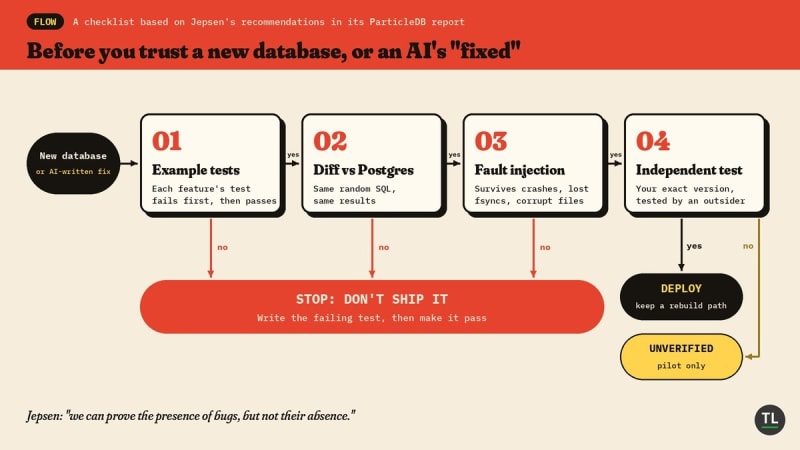
A four-step trust check before you ship a new database
Prompt-level trust is the same lesson from a different angle, as we saw when a stray AGENTS.md file could hijack Codex and Claude Code.
What's Next
The open question is whether 1.1.19-rc.13, or the current rc.16, actually holds up. Jepsen says it "can prove the presence of bugs, but not their absence," and it hasn't tested either build.
Plenty remains untested, too. Jepsen didn't evaluate replication, the Redis and HTTP APIs, vector search, or multi-tenancy, and it flags Orkes' new Python and Rust stored procedures as worth a closer look.
We couldn't find a public statement from Orkes beyond its updated docs and release notes. And Jepsen's broader question is still open: "In the age of LLMs, what can maintainers do to ensure correct software and accurate documentation?"
FAQ
What is ParticleDB?
It's a Rust-based multi-model database from Orkes that speaks the Postgres and Redis protocols and targets AI agents and applications. Orkes originally built it to back its Conductor orchestration platform.
Is the latest ParticleDB version safe to use?
Nobody independent has said so yet. Orkes claims 1.1.19-rc.13 fixes the remaining issues, but Jepsen tested only up to 1.1.18.11.rc-22 and still recommends halting deployment.
Did AI cause ParticleDB's bugs?
Jepsen doesn't blame a single cause. It points to structural QA gaps, suggests "perhaps engineers entrusted Large Language Models with the work of testing," and says LLM tooling repeatedly claimed fixes that hadn't happened.
Sources
Jepsen's ParticleDB test suite, GitHub
ParticleDB releases and client availability, ParticleDB (Orkes)
Discussion of Jepsen's ParticleDB report, Hacker News
Follow TheTechLane
Keep learning AI, development, and modern developer technologies with TheTechLane.
Learn • Build • Share
Follow @thetechlanehq for more developer guides, tutorials, and practical technology content.