Cloudflare Takes Over tsrs, a Rust Port of TypeScript Built by AI Agents
Cloudflare and VoidZero are taking over tsrs, an AI-agent-written Rust port of TypeScript that claims 8x faster checks. Here's what it means for your builds.

Cloudflare is taking over tsrs, a Rust port of the TypeScript compiler that it says type-checks up to 8x faster than TypeScript 7.0 while using about 70% less memory. The port was written almost entirely by AI coding agents, and Cloudflare insists it isn't a fork.
Here's what you need to know:
tsrs is a Rust port of the TypeScript 7 compiler and language server, now developed by Cloudflare and VoidZero inside the Oxc toolchain.
Cloudflare's early benchmarks show up to 8x faster checks and ~70% less memory than TypeScript 7.0 with the same number of workers.
It started at Owner.com, where Max Schwenk says AI agents wrote the port and he "wrote zero code."
The work is happening "in close collaboration with the TypeScript team," and TypeScript 7.1 beta is already up to 2.5x faster, partly from ideas upstreamed from tsrs.
It's experimental and on npm today:
pnpm add -D tsrs.
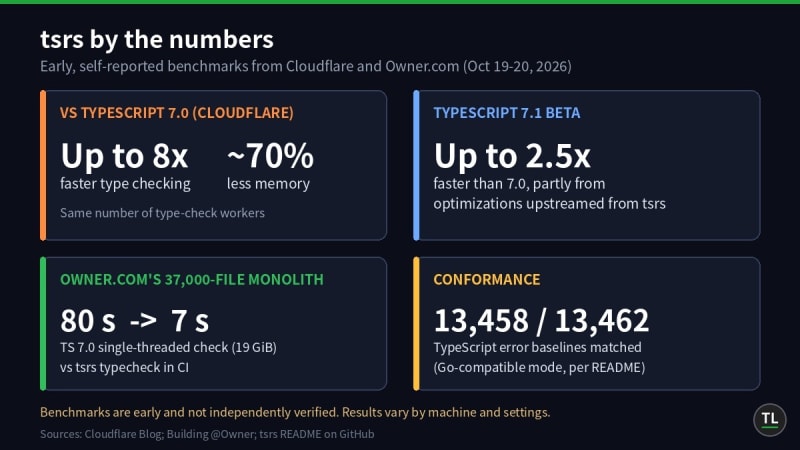
tsrs by the numbers. All figures are early and self-reported.
What Happened
Cloudflare announced the move on October 20 in Cloudflare's tsrs announcement, written by Boshen Chen, Dimitri Mitropoulos and Christoph Nakazawa. Cloudflare and VoidZero are now working with Max Schwenk of Owner.com on the port and incubating it as part of Oxc, the Rust-based JavaScript toolchain.
"To be clear, we are not forking TypeScript," the authors wrote. They said the TypeScript team "should remain in full control of the language's design and direction," and that a port has to follow those decisions closely "or it will eventually fall apart and become incompatible."
Nakazawa, Cloudflare's director of engineering, summed it up on X: "We are not forking TypeScript – we are working with the TypeScript team and as a result 7.1 is already ~2.5x faster, too," as quoted by The New Stack.
The project's origin story is the bigger surprise. In Owner's engineering blog post on tsrs, Schwenk says Owner's backend monolith is about 37,000 TypeScript files checked as one program. On TypeScript 7.0, a single-threaded check needed 19 GiB of memory and 80 seconds.
So he had AI agents port the Go compiler to Rust. The New Stack reports he used Anthropic's Claude Opus 5.5 and more than 20 subagents in parallel. "I wrote zero code," Schwenk writes. "Not 'barely any'. Zero." Owner's typecheck now takes seven seconds in CI and about twelve on a MacBook.
Correctness is the obvious worry with an agent-written compiler. The tsrs README on GitHub says it matches the reference on 13,458 of 13,462 error baselines in TypeScript's conformance suite, in Go-compatible mode. The repo now lives under the oxc-project organisation.
Why It Matters
Microsoft's own Go port already made TypeScript about 10x faster than the JavaScript version, per Cloudflare. So why another native compiler? Cloudflare's answer is WebAssembly.
Compiling Go to Wasm means shipping Go's garbage collector inside the module. Rust doesn't need one, which makes for leaner memory between a Wasm guest and its host. That matters when you want to run full build toolchains inside sandboxes on Cloudflare Workers, or right in a browser.
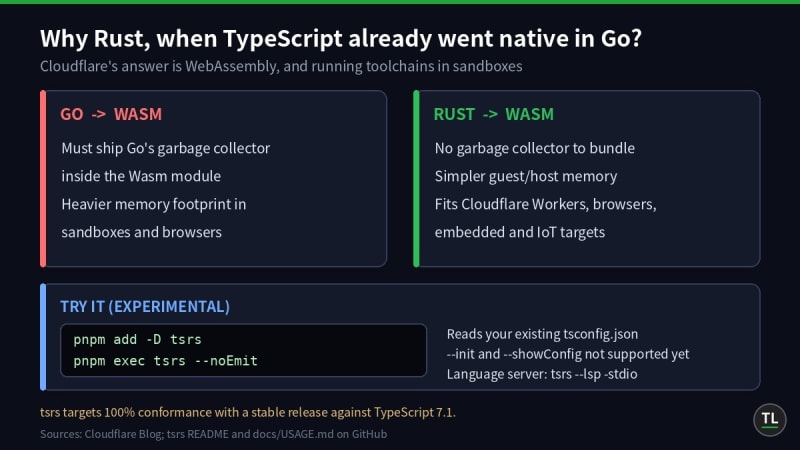
Cloudflare's case for Rust is about WebAssembly, not just raw speed.
It's also an agent story. Schwenk's whole point was that coding agents need typecheck, lint and format to run in a tight loop wherever they work. When checks eat tens of gigabytes, you can't run several agents in parallel on one laptop. That's the same agent-everywhere shift behind stories like the AI agents that hacked 100+ sites.
And it shows how fast "port it with AI" has become real. Cloudflare's blog notes frontier models "can now do large-scale ports almost independently in a matter of days." Owner's post says Theo Browne released his own Rust port in mid-October and Bun shipped its own checker.
What It Means for Developers
You don't have to pick a side yet. tsrs is designed as a drop-in for tsc, so trying it costs very little.
Try it on a branch. Run
pnpm add -D tsrsandpnpm exec tsrs --noEmit. Your existingtsconfig.jsonstill controls everything, per the tsrs usage docs.Benchmark on your own repo. Cloudflare warns that many port benchmarks use bigger machines and non-default options. Compare against TypeScript 7.1 beta too, since it's already faster.
Don't swap it into release builds yet. It's experimental.
--initand--showConfigaren't supported, and diagnostics can print in a different order than upstream.Watch memory if you run agents. If your CI or local agents are bottlenecked on typecheck memory, this is the use case tsrs was built for.
Keep an eye on Oxlint. Cloudflare plans deeper integrations, such as type-aware lint rules in Oxlint.
What's Next
Cloudflare says it's working with Theo Browne to merge his tsc-rs project and tsrs into one package covering all of TypeScript's features, including the language server. It plans to keep tsrs in sync with upstream using daily agent-driven diff reviews and nightly test runs, the same process it uses for Vinext.
The maintainers aim to ship a stable release against TypeScript 7.1 with 100% conformance, according to the README. No date has been given.
The open questions: how long a small team can track every upstream change, and whether the speed gap shrinks as the TypeScript team keeps pulling optimisations into its Go compiler. Cloudflare has also said it'll send performance fixes back upstream so "everyone wins." It's worth watching whether that keeps happening. For another big open-source drop from this week, see our take on DeepSeek's DeepInfer release.
FAQ
What is tsrs?
tsrs is a Rust port of the TypeScript 7 compiler and language server. It aims to be a drop-in replacement for tsc with faster type checking and lower memory use.
Is Cloudflare forking TypeScript?
No. Cloudflare says the TypeScript team stays in full control of the language, and tsrs will follow upstream behaviour strictly while contributing performance fixes back.
Should I switch my project to tsrs today?
Only to experiment. It's an early, experimental release with some unsupported commands, so test it alongside tsc before relying on it.
Sources
Introducing tsrs: a Port of TypeScript to Rust, Cloudflare Blog
tsrs: a Rust port of TypeScript, written entirely by agents, Building @Owner
tsrs README, GitHub
tsrs usage docs, oxc-project on GitHub
tsrs package, npm
"We are not forking TypeScript": Cloudflare spearheads Rust port written by agents, for agents, The New Stack
Cloudflare and VoidZero Take On tsrs, a Rust Port of the TypeScript Compiler, WebProNews
Follow TheTechLane
Keep learning AI, development, and modern developer technologies with TheTechLane. Learn • Build • Share Follow @thetechlanehq for more developer guides, tutorials, and practical technology content.