DeepSeek's V4.1-Flash Update Ships a $0.75 Search API for AI Agents
DeepSeek's V4.1-Flash-1017 jumps on coding and agent benchmarks, and its new Search & Fetch APIs cost $0.75 per 1,000 calls. Here's what developers get.

DeepSeek has shipped DeepSeek-V4.1-Flash-1017, an open-weight update that posts double-digit gains on agentic coding benchmarks, and it's opening its in-house web search engine to every developer at $0.75 per 1,000 calls. The Chinese lab announced both on October 17 in a four-post thread on X.
Here's what you need to know:
Terminal-Bench 4.0 jumps to 42.3 from 31.2, and ProgramBench climbs to 29.1 from 20.3, according to DeepSeek.
The model is a drop-in swap: keep calling
deepseek-flashand you get the new version.Weights are out under the MIT license on Hugging Face and ModelScope.
New Search & Fetch APIs cost $0.75 per 1,000 successful requests per endpoint.
Server-side search calls via DeepSeek Harness, Claude Code and Codex are free until October 31, 16:00 UTC (9:30 PM IST).

DeepSeek's own numbers: the biggest jumps are on agentic coding benchmarks.
What Happened
"DeepSeek-V4.1-Flash-1017 is here!" the company wrote in its launch post on X, promising "stronger benchmark performance, faster task completion, and shorter outputs than the previous version." It called that "a Pareto improvement in performance and cost." The model is live on DeepSeek's website, app and API.
The Hugging Face model card calls it "a minor update" to September's V4.1-Flash. It lists Humanity's Last Exam (no tools) at 42.6, up from 36.8. DeepSWE v1.1 rises to 77.0 from 74.2. DeepSeek says it ran Terminal-Bench 4.0 with the Claude Code harness. These are the company's own figures, not independent tests.
The gains come from "reinforcement learning with self-feedback" aimed at "end-to-end project development—from game creation to 3D modeling," DeepSeek said in the second post of the thread.
For API users, nothing breaks. DeepSeek's API docs say deepseek-flash "is now served by DeepSeek-V4.1-Flash-1017, and the calling method remains unchanged." The legacy names deepseek-v4-flash and deepseek-v4-flash-vision-exp still work. They now route to the new model and are billed at the Flash price. Quartz reports that pricing is unchanged.
Then came the bigger developer story. "Search & Fetch APIs are now open to everyone!" DeepSeek posted in the third post of the thread. It says the in-house engine behind them serves "hundreds of millions of requests daily worldwide." The docs don't repeat that figure.
Why It Matters
DeepSeek keeps squeezing the price-performance curve. The Straits Times, carrying Bloomberg's report, says September's V4.1-Flash was priced so aggressively that shares of rivals such as MiniMax, Z.ai and Alibaba fell in Hong Kong. The same report points to strain: DeepSeek had an outage of about five hours earlier in the week.
The search API may matter more than the benchmarks. Agents and RAG apps need fresh web data, and that has been expensive. PPC Land compares the price with Brave's search API at $5 per 1,000 requests and Microsoft's Grounding with Bing Search at $35 per 1,000 transactions. Those aren't identical products, but the gap is big.
There's a quieter detail too. DeepSeek's guide says that when you run its API through DeepSeek Harness, Claude Code or Codex, "server-side tool calls already hit the Search and Fetch APIs." So if you've pointed those tools at DeepSeek, its search engine is already answering your agent's web lookups.
What It Means for Developers
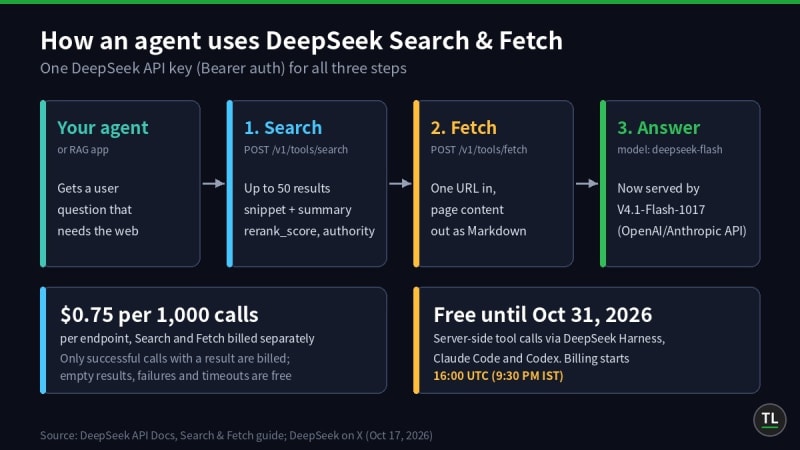
How an agent can chain Search, Fetch and deepseek-flash with one API key.
Re-run your evals. If you call
deepseek-flash, you're already on the new model. Check output length, latency and tool-call behaviour on your own tasks.Try the search endpoint. It's a raw JSON API on your existing DeepSeek key. Here's the Python example from DeepSeek's Search & Fetch guide:
import requests

response = requests.post(
    "https://api.deepseek.com/v1/tools/search",
    headers={
        "Authorization": "Bearer <DeepSeek API Key>",
    },
    json={
        "query": "DeepSeek V4 release",
        "count": 5,
        "need_content": True,
    },
)
response.raise_for_status()
for result in response.json()["results"]:
    print(result["title"], result["url"])
    print(result["summary"])
Use the right endpoint. Search returns up to 50 results with a short
snippetfor UIs and a longersummarymeant for models. Fetch (/v1/tools/fetch) turns one URL into Markdown.Know the billing rules. Only HTTP 200 calls with a result are billed. Empty results, failures and timeouts are free, and
countdoesn't change the price.Plan for rate limits. The guide currently lists 100 queries per second for Search and 25 for Fetch per account, plus a per-domain cap on Fetch. PPC Land reported 5 per second at launch, so check before you scale.
Mark October 31 on the calendar. Free server-side calls end at 16:00 UTC (9:30 PM IST). The guide states it as midnight Beijing time on November 1.
Run it yourself if you prefer. The MIT-licensed weights support a 1M-token context, per the model card. If you're building retrieval, our guide to building a simple RAG application using Python is a good starting point.
What's Next
The free window is the near-term test. After October 31, teams running Claude Code or Codex on DeepSeek will start paying for every server-side search and fetch.
Here's what DeepSeek hasn't said yet:
How the Fetch crawler identifies itself, or whether it checks robots.txt. PPC Land notes the docs are silent on both.
How it assigns the
authoritytier attached to each search result.Whether the rate limits will keep changing.
How it'll keep up with demand after last week's outage.
Pricing pressure is the other thing to watch. Our look at AI coding agents in 2026 explains why cheap models and cheap tools matter so much to agent builders.
FAQ
Do I need to change my code to use DeepSeek-V4.1-Flash-1017?
No. DeepSeek says deepseek-flash now serves the new model and the calling method is unchanged. The legacy deepseek-v4-flash names also route to it.
How much do DeepSeek's Search and Fetch APIs cost?
Each endpoint costs $0.75 per 1,000 successful requests. Failed calls, empty search results and timeouts aren't billed.
Is search in Claude Code and Codex free on DeepSeek?
For now. Server-side Search and Fetch calls through DeepSeek Harness, Claude Code and Codex are free until October 31, 2026, at 16:00 UTC (9:30 PM IST).
Sources
Post on project development and RL with self-feedback, DeepSeek
Search & Fetch API announcement on X, DeepSeek
DeepSeek-V4.1-Flash-1017 model card, Hugging Face
Your First API Call (model names and update note), DeepSeek API Docs
Search & Fetch guide, DeepSeek API Docs
DeepSeek pushes out "faster, leaner" updated AI model, The Straits Times / Bloomberg
DeepSeek prices web search for AI agents at $0.75 per 1,000 calls, PPC Land
Follow TheTechLane
Keep learning AI, development, and modern developer technologies with TheTechLane.
Learn • Build • Share
Follow @thetechlanehq for more developer guides, tutorials, and practical technology content.